FIRAS

Broadsword launch Fire Protection Arm

We are proud to announce that we have launched a new Fire Protection Arm of the Company.

Broadsword are experts in fire protection and are FIRAS accredited.

Most companies do not realise that they need fire protection and if they do, they don’t know where they can get it.  

Broadsword Fire Protection LTD can make sure that your building is protected from fire, we can also retrospectively assist with existing buildings.

Building regulations outline the need for large buildings to be divided into compartments and specifies the level of fire performance the compartment walls and floors need to achieve in order to preserve both building structure and life through fire and smoke containment.

In most buildings, mechanical and electrical services by necessity breach compartment walls and floors allowing failure of integrity and insulation to occur where gaps around services have not been adequately fire stopped. The use of correctly installed certified fire stopping systems will contain a fire at its source and limit the risk of the destruction caused by the spread of fire and the release of toxic gasses.

If you require a competent fully accredited fire protection company, you have just found it!

Broadsword Fire Protection LTD welcomes your enquiries.

energy performance

The energy performance of commercial buildings needs improvement

The government has published a consultation paper with proposals setting a minimum energy efficiency standard of EPC Band B by 2030 for privately rented buildings. 

Alongside this, the government promises to consult in 2020 on introducing mandatory in-use energy performance ratings for business buildings.

The move come in response to recommendations from the Committee on Climate Change (CCC) earlier this year and extensive lobbying by the UK Green Building Council (UKGBC).

UKGBC chief executive Julie Hirigoyen said: “Today’s announcement is most encouraging, as we have long called for more ambitious policies to improve the energy performance of our commercial buildings.  It is also a welcome complement to the government’s recently announced plans to strengthen energy efficiency standards for new homes – and shows that they are finally understanding the importance of tackling buildings emissions as we strive to meet our climate targets.

“By signalling a long-term Band B target for rented commercial buildings, the government is providing welcome certainty, which will help underpin businesses’ energy improvement plans and the supporting investment decisions.  As the market has already shown, minimum standards for rented buildings can have a transformative effect on their performance.

“We are also pleased to see the government at last acknowledging the importance of mandatory operational energy ratings for commercial buildings.  There is strong evidence from the Australian NABERS scheme, amongst others, that mandatory operational ratings can radically drive down energy use and reduce emissions.  The best-performing business buildings in Melbourne use between five and six times less energy than their London equivalents.”

Source: The Construction Index

flag

Industry backing for the government to relax its post-Brexit immigration proposals

The Construction Industry Training Board (CITB) report calls for the proposed one-year visa for ‘low-skilled’ workers to be extended to two years.

It also recommends that non-UK born workers entering the UK on a ‘low skilled’ visa be allowed to transition to a ‘high-skilled’ visa while working in the UK – train to remain.

And it proposes an ‘umbrella sponsorship’ scheme to allow self-employed non-UK workers to obtain the necessary employment sponsorship.

The CITB’s research found that 61% of migrants say they would choose to move from a ‘low’ to a ‘high’ skilled visa while continuing to work in the UK, and that 70% of employers of non-UK born construction workers see the ‘low skilled’ visa for people with level 2 qualifications as unsuitable for their businesses

The research report, Migration and Construction, finds that just 3% of construction employers have the necessary experience in handling visa applications, with two-thirds saying that the process is difficult.

Under the new post-Brexit immigration system – due to be introduced in January 2021 – employers will have to learn how to navigate the bureaucracy of visa applications for all foreign workers.

CITB policy director Steve Radley said: “Migrant workers have long played a key role in the UK’s construction sector. They make up 14% of the construction workforce, a percentage that rises to 54% in London. They give employers the flexibility to respond quickly to skills needs.

“Employers are raising real concerns about the future 12 month visa scheme. They want to see it extended to 24 months, and for workers to be given the opportunity to ‘train to remain’. A new scheme must additionally be put in place to enable self-employed migrants to work in the sector.

“It’s important that construction has the breathing space to adjust to new changes. CITB will work closely with Government to see that a simple, flexible migration system is put in place to support employers’ skills requirements, while industry grows its domestic workforce.”

Contractors have backed the recommendations

Alasdair Reisner, chief executive of the Civil Engineering Contractors Association (CECA), said: “The construction and infrastructure sectors have been facing a looming skills gap for some years, and it is deeply concerning that after the UK has left the European Union restrictions may be put in place to prevent non-UK born workers contributing to our industry.

“Currently, non-UK born workers account for 14% of UK construction’s workforce, rising to 54% in London.

“Industry is in the process of moving towards recruiting an extra 44,000 British-based people in construction by 2025 to meet projected demand.

“However for UK construction to achieve this goal while delivering the significant pipeline of projects the UK government has planned, those who currently contribute to our industry and the economic and social wellbeing of us all must be given the opportunity to continue to do so. That’s why we are calling on the government to take steps to ensure industry is ready for the post-Brexit migration landscape, by extending the period in which existing non-UK born workers are able to ‘train to remain.’

“Employers in the construction sector are actively working to grow the domestic workforce, but it will take time to do so. Unless the UK government changes its position, industry will be hamstrung in the immediate post-Brexit period, to the detriment of its ability to drive growth and deliver for the UK economy.”

Brian Berry, chief executive of the Federation of Master Builders, said: “The CITB report is absolutely right to highlight the barriers facing construction employers needing to employ non-UK workers. The government needs to look again at its post-Brexit immigration system to make it easier and simpler for small building companies needing to recruit non-UK labour. There is currently a serious skills crisis in the building industry which explains why 9% of the construction workforce is made up of EU workers. Given it takes many years to train a high-quality tradesperson there will, in the short term at least, continue be an urgent need to recruit non-UK labour. Without this labour the industry will not be able to deliver the homes and key infrastructure projects that are needed to underpin the UK’s national productivity and growth.”Mr Berry concluded: “The current non-EU migration system is exceptionally difficult for small employers to engage with taking as long as eight months in some instances to secure specialist tradespeople to come to the UK to work on sites. Most small businesses simply don’t have the time and resources to take that on. It would be very damaging just to extend this system to EU workers without seriously reforming it. Extending ‘low skilled’ visas from 12 months to 24 months; allowing non-UK born workers the opportunity to transition to a ‘high skilled’ visa; and the creation of an ‘umbrella sponsorship’ scheme would help ease concerns about how construction companies are going to fill the skills gaps.”

Souce: The Construction Index

Housing

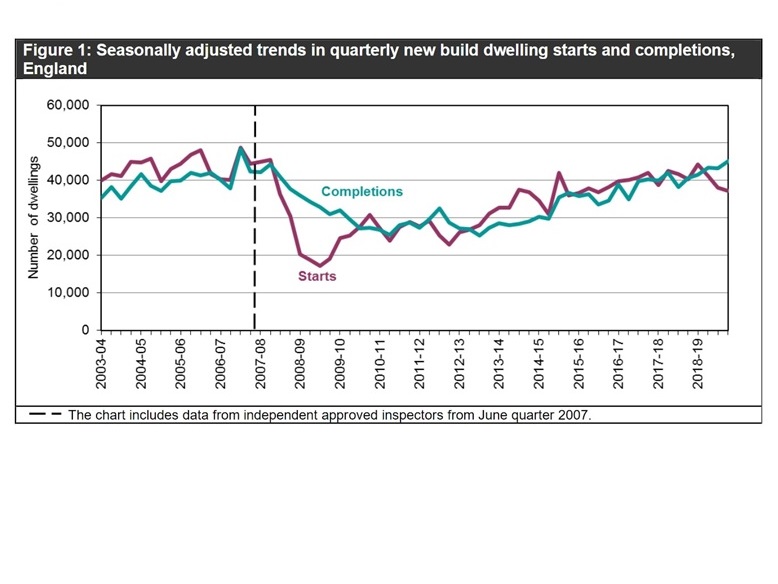
House-building starts down 8% year-on-year

In the second quarter of 2019 new build dwelling starts in England are estimated at 37,220 units (seasonally adjusted), which is a 2% decrease compared to the first quarter and 8% down year-on-year.

New house-building starts are 24% below their peak in Q1 2007 but 117% per cent above the trough Q1 of 2009.

According to the numbers released by the Ministry of Housing, Communities & Local Government, annual new build dwelling starts totalled 160,640 in the year to 30th June 2019, a 1% decrease on the previous.

During the same period, completions reached 173,660 in the year to June, an increase of 8% on the previous year.

Secretary of state for housing Robert Jenrick preferred to focus on the rise in completions rather than the fall in starts. “The data released today is hugely welcome, with the number of new homes built reaching an 11-year high,” he said. “We are moving in the right direction, but there is still much more to do if we are going to deliver the numbers needed by communities up and down the country.”

Clive Docwra, managing director of construction consultant McBains, said: “Today’s figures show the amount of new homes being started or completed are still nowhere near the number required to meet the government’s target of building 300,000 homes a year by the mid 2020s.

“Brexit uncertainty continues to bite, with many housebuilding projects on hold until the picture on the UK withdrawal from the EU becomes clearer, while the weak pound means the high cost of imported materials is holding back construction.

“Demand for housing is far outstripping supply, but today’s figures prove there is still no light at the end of the tunnel in terms of solving the housing crisis.”

Source: The Ministry of Housing, Communities & Local Government

Source: The Construction Index

SPS Envirowall

Why use SPS Envirowall’s Cavity System wall insulation?

SPS Envirowall’s Cavity System is the latest fully tested and accredited addition to its expanding range of innovative external wall insulation systems.

Extensively used on lightweight structures, cavity systems create a drainage void between the cladding and the sheathed framed structure. SPS Envirowall Cavity Systems 1 & 2 are the next generation of this solution.

This modern method of construction has proven extremely popular over recent years and dominates the build method used for mid to high rise structures, which is an ideal scenario to specify and install the new SPSenvirowall Cavity Systems.

The SPS Envirowall Cavity Systems consist of EuroClass A1 components, which are mechanically fixed back to the inner sheathing board to create the designed cavity width, with either the insulation board fitted directly to the A1 fillets (CS1 system) or a secondary A1 sheathing board and insulation (CS2 system).

Features & Benefits

• Compliant with Approved Document B and Technical Handbook section 2
• Minimum EuroClass Reaction to Fire classification of A2 – s1, d0
• EuroClass A1 support system
• Takes cladding out of the critical path by quickly weatherproofing the building
• Low-cost cladding solution
• Fast application
• Tried and tested
• Wide range of colours and finishes including brick slips
• Easily achieves high levels of thermal performance
• Highly durable and weather resistant
• Crack resistant

Façade Finishes

•Textured: FlexiSil (Acrylic), EnviroSil (Silicone), Enviromin (Mineral)
• Brick: SpeedySlip (Flexible Slip), BrickStick (Clay Slip),

Suitable for the following construction types

• Lightweight Framed Structures (LSF)
For more information and brochure download:

https://spsenvirowall.co.uk/assets/technical-resources/SPSenvirowall-Cavity-System-1-2.pdf

Source: The Loadstar

septic tank

New Septic Tank Regulations in England & Wales deadline approaching

From January 1, 2020, the new septic tank regulations will be in place for England and Wales.

All septic tank types that discharge to surface water will require either upgrading or replacement with a sewage treatment plant.

Under the new code of practice by the Environment Agency, homeowners are responsible for the installation and required maintenance of the sewage treatment system on their property, and to limit its impact on the local environment.

Septic tanks can no longer discharge directly into a watercourse must upgrade their sewage treatment system by January 1, 2020, or sooner if the property is going up for sale before this deadline. The tank will also require replacement if the Environmental Agency (EA) finds that it is causing pollution.

In accordance with these regulations, a septic tank or wastewater treatment plant has to meet British Standards BS EN 12566, while any drainage field is required to meet BS EN 6297:2007 standards. The new rules aim to reduce the level of pollution present in national waterways by better controlling and regulating discharge requirements to a watercourse.

The goal is to significantly reduce the level of pollution currently present in national waterways through better control and regulation of discharge requirements to a watercourse. This upgrade to your sewage treatment system must be in place by January 1, 2020, or when you sell the property (if selling before this date).

If buying or selling a property before the 2020 deadline, you are legally required to inform any potential buyers in writing if the property has a septic tank as well as provide all information regarding maintenance requirements and the location of the system.

The Environmental Agency will carry out inspections to enforce the adoption of the new rules. If found to be currently polluting surface water due to discharge from a septic tank, you will be required to install a new system before the deadline.

Any system installed before 1983, prior and the establishment of current standards will most likely need replacement. An existing unit requires the following to be compliant;

  • CE certificate
  • Compliance with BS standards
  • Unit and soakaway system to have been installed correctly
  • Regular maintenance and emptying

For additional information about the 2020 changes to the septic tank regulations, visit tricel.co.uk/septic-tank-regulations-2020

Source: The Loadstar / Tricel.co.uk

house funding

Government needs to spend around £146bn over the next 10 years to deliver the homes the UK needs

It is a huge sum, but says head of Policy James Prestwich, social housing is a crucial infrastructure and investing in it will benefit the wider economy.

This year, we mark the centenary of a landmark piece of legislation, which has fundamentally shaped the housing system in this country – perhaps more than any other. The end of the First World War created huge demand for affordable homes across the country, which led to the passage of the Housing & Planning Act of 1919. Now better known as the Addison Act – after Dr Christopher Addison, the then-minister of health and the bill’s author – it set in motion the whole system of social housing we know today.

It made housing a public responsibility for the first time, establishing the principle that the government must ensure there are enough decent, affordable homes to go around. It’s a noble vision, and it’s vital that we don’t lose sight of it.

Now, 100 years on, what does our housing system – especially social housing – look like? For many of us, the cracks are clear to see: rough sleeping is up 165% on 2010 levels, while temporary accommodation is full to bursting. The amount of social housing has fallen, leaving expensive and insecure private renting as the only real alternative for millions of people. This is having dire consequences – 1.3m children are now growing up in poverty in the private rented sector.

Why has this happened, a century on from a landmark law that made the government responsible for ensuring everyone had a decent home? The answer is that, for decades, successive governments of all parties have failed to invest enough in affordable housing. In 1953, the government spent £11.3bn in today’s prices on building new social housing – by last year, this figure had fallen to just £1.27bn.

Ultimately, this is a problem that has been caused by lack of investment. It means that the solution lies in renewed investment, targeted to deliver the social housing the country desperately needs.

Now, for the first time, we can put a price on how much money is required. Over the next 10 years, the government should invest £146bn in building social housing. Per year, this works out at an average of around £12.8bn, in today’s prices.

Of course, this feels like a vast sum of money – and it is. The housing crisis is deeply entrenched, and can’t be solved easily. It will take political will and a significant long-term investment to finally bring it to an end.

However, it’s important to put this figure in perspective. The government already spends about £10bn every year just on roads. The logic is simple: they’re a vital part of our infrastructure and we need a functioning road system to keep the country moving, so the government invests in it. That same logic should also apply to housing.

As well as providing the social homes the country desperately needs, this investment would have wider benefits for everyone. By spending £12.8bn each year, the government could create an economic boom. It would add £120bn to the economy annually, supporting businesses and new jobs, and helping to boost the economy.

Meanwhile, this investment would also save the government money. By building new social housing, more and more people could move out of expensive temporary accommodation or privately rented homes, and into social housing where they can afford the rent and put down roots. This would, in turn, bring down the colossal housing benefit bill, which reached the dizzying heights of £22.3bn last year.

Of course, spending this money won’t fix the problem overnight – the housing crisis requires a long-term perspective and long-term certainty. This would allow the funding to be ramped up, with less money in initial years of the programme as new jobs are created. Then, when additional capacity is in place, more money can be spent in later years.

What’s important is that the government invests the desperately needed money that is required to end the housing crisis. Underfunding is the biggest cause of this crisis, so it must be part of the solution. For the first time, we know exactly what it will take to end this economic, social and human catastrophe. We can also reap the economic rewards of this spending programme, creating new jobs and supporting businesses across the country.

Now that we know what needs to be done, it’s up to the government to take the lead and make it happen.

Source: PBC today

uk construction

“Brexit fatigue” sees surveyors report construction output grow

The industry is getting on with life as its patience with Brexit related indecision wears thin according to the latest RICS Construction and Infrastructure Market Survey.

Quarter two results show output growth accelerating and workload and employment expectations gathering pace for the year ahead.

The quarter saw 16% more surveyors reporting an increase in construction workloads, up from a +9% net balance in Q1.

RICS Senior Economist, Jeffrey Matsu, said: “Three years on and the long, unrelenting shadow of Brexit uncertainty is testing the mettle of the construction industry.

“After a prolonged period of delays and underinvestment, businesses now appear to be fed up and are proceeding cautiously with new hiring and intentions to invest.

“While much of this is likely to be backfilling or maintaining existing capacity, the requirements of larger projects such as Hinkley Point C and HS2 are constraining growth opportunities elsewhere.

“With the range of possible outcomes related to Brexit as wide as ever, we expect to see continued volatility in the construction output data but in the meanwhile foresee workload activity stabilising.”

Following a dip in Q1, workloads in the infrastructure sector improved in Q2 and there was also modest growth in commercial and public non-housing activity.

Looking to the year ahead, workloads are expected to be most resilient in the private housing and infrastructure sectors with 27% and 25% more surveyors, respectively, anticipating activity to rise rather than fall.

The RICS market confidence indicator – a composite measure of workload, employment and profit margin expectations over the coming twelve months – rebounded to 21% (from 13% in Q1).

Investments related to equipment, software and worker training are expected to gather pace as well.

Source: Construction Enquirer

house funding

Theresa May calls for tougher design rules to prevent ‘tiny homes’

Theresa May has called for mandatory design standards for new houses, saying the number of “tiny homes” with little storage on the market is indefensible.

The prime minister said the lack of universal, enforceable rules on the amount of internal space is encouraging a “race to the bottom” among builders.

If all councils made those rules a pre-condition of planning, it would end the “postcode lottery”, she argued.

MPs, meanwhile, say residents should be compensated for design flaws.

The cross-party Commons Public Accounts Committee said there needed to be a clear definition of what was acceptable in terms of the quality of new housing.

In a new report, it said it was particularly concerned about offices and commercial buildings being converted into residential properties.

The government is reviewing its policy of allowing the conversion of offices into homes without planning permission.

What are the rules?

Guidelines specifying minimum bedroom size, floor areas for storage and floor to ceiling heights for new builds in England have been in place for several years and were last updated in 2016.

But the Nationally Described Space Standards are not compulsory, and are only applicable if councils adopt them as part of their local housing plan.

What does the PM want?

In a speech to the Chartered Institute of Housing in Manchester, Mrs May said there are different standards in different areas.

While the government remained committed to a massive expansion in house building over the next decade, hoping to reach a target of 300,000 new homes a year by the mid 2020s, she said this cannot come at the expense of quality.

“I cannot defend a system in which owners and tenants are forced to accept tiny homes with inadequate storage,” she said.

“Where developers feel the need to fill show homes with deceptively small furniture. And where the lack of universal standards encourages a race to the bottom.”

The government wants to see design requirements incorporated into the planning process for the first time.

But MPs have expressed concerns that too many councils’ housing plans are out of date and some town halls do not have a blueprint at all due to its cost and complexity.

The Public Accounts Committee said ministers were reluctant to intervene and use their powers to develop a plan centrally because of concerns over localism.

Why is housing such a key issue?

The Local Government Association, which represents more than 300 councils in England and Wales, said there needed to be more leadership from government on the issue so councils, developers and home buyers knew where they stood.

“High-quality homes for affordable and social rent are desperately needed across the country now,” said Martin Tett, the organisation’s housing spokesman.

“These standards should future-proof all new homes ensuring they are accessible for all ages and all markets, meet the housing needs of our ageing population and are environmentally sustainable.”

Shelter said it applauded efforts to improve the quality of new homes but the reality was that most first-time buyers could simply not afford to get on the housing ladder.

It said ministers’ efforts should be focused on removing disincentives in the market to build social housing.

“What this country needs – and what it wants – is a commitment from the top, from any prime minister, to a renewal of social housing,” said its chief executive Polly Neate.

Source: BBC.co.uk

fire

2 years post Grenfell, do new regulations go far enough?

The Fire Protection Association, the UK’s national fire safety organisation, is highlighting that, if we want to prevent another Grenfell Tower tragedy, it’s time for some immediate change. The organisation remains firm in its message that two years after “Grenfell”, the government’s changes to building regulations and the so-called ban on combustible cladding do not go far enough in protecting buildings and the people who live in them, from fire.

The Fire Protection Association says the solution should be:

  • Third party certification – we welcome the acknowledgement of the value of independently verified products, but believe this assurance should be mandated and extend to the installers of products and the risk assessors
  • Extending the ban on combustibles to all high-risk buildings regardless of height – not just buildings over 18 metres
  • Ban single staircases in building in excess of 18m – to offer both an entrance and exit staircase
  • Mandatory installation of multi sensor detection for all high-risk occupancies – a fire detector that monitors a number of potential dangers, including smoke, heat, carbon-monoxide

Jonathan O’Neill, OBE, managing director, Fire Protection Association commented:

“The Fire Protection Association supports a total ban on combustible building materials, to all high-risk buildings, such as schools, hospitals, nursing homes, blocks of flats – not just those buildings over 18 metres. We also want a ban on single staircases in all tall buildings, because in the event of a fire you need at least one staircase for people to be able to evacuate the building, and a second staircase for the fire and rescue services for entry. Our support of third-party certification, to provide independent verification of building regulations services, as well as the mandatory installation of multi sensor detectors (that can detect several sources, such as heat, smoke and carbon monoxide) is also a key consideration. There is clearly much that still needs to be done, so we are keen to see change now – and will help in any way we can to ensure that we never again experience a tragedy on the scale we witnessed at Grenfell.”